Colour theory 101

Finding colour combinations is my kind of nirvana. I used to make colour decisions based on my gut feeling, and I still do, but learning colour theory in my training really helped me to unlock another level of comprehension, or at least be able to explain my choices.
Here are a few starting points that will make you see colour differently.
The colour wheel
First of all, I would like to introduce you to the wheel. You see that little colourful wheel in my picture above? Yes, this one! You can find it online for very little money. It contains the primary colours (red, blue, yellow), the secondary colours (orange, green, purple) and the tertiary colours (like red-orange, yellow-green, or blue-purple). In each funnel/column of each colour, you can see that same colour being mixed with white, then grey, then black.
Now that you know the wheel herself a bit better, let’s get into the fun part. On the wheel you will find the different colour scheme possibilities, meaning how you can find which colours work together. There are several kinds of colour scheme possibilities, but I would say you should start with two easy ones: the complementary scheme or the monochromatic scheme.
The complementary scheme
It means to take two colours on opposite sides of the wheel, like red and green. It’s my favourite scheme! Of course, in interior design we rarely work with strictly saturated colours, so you can move along that red funnel and that green funnel and find colours that are a bit more muted. You can put a lovely light pink with a sage green together and it will work wonders. Here you go, you made your first combination!
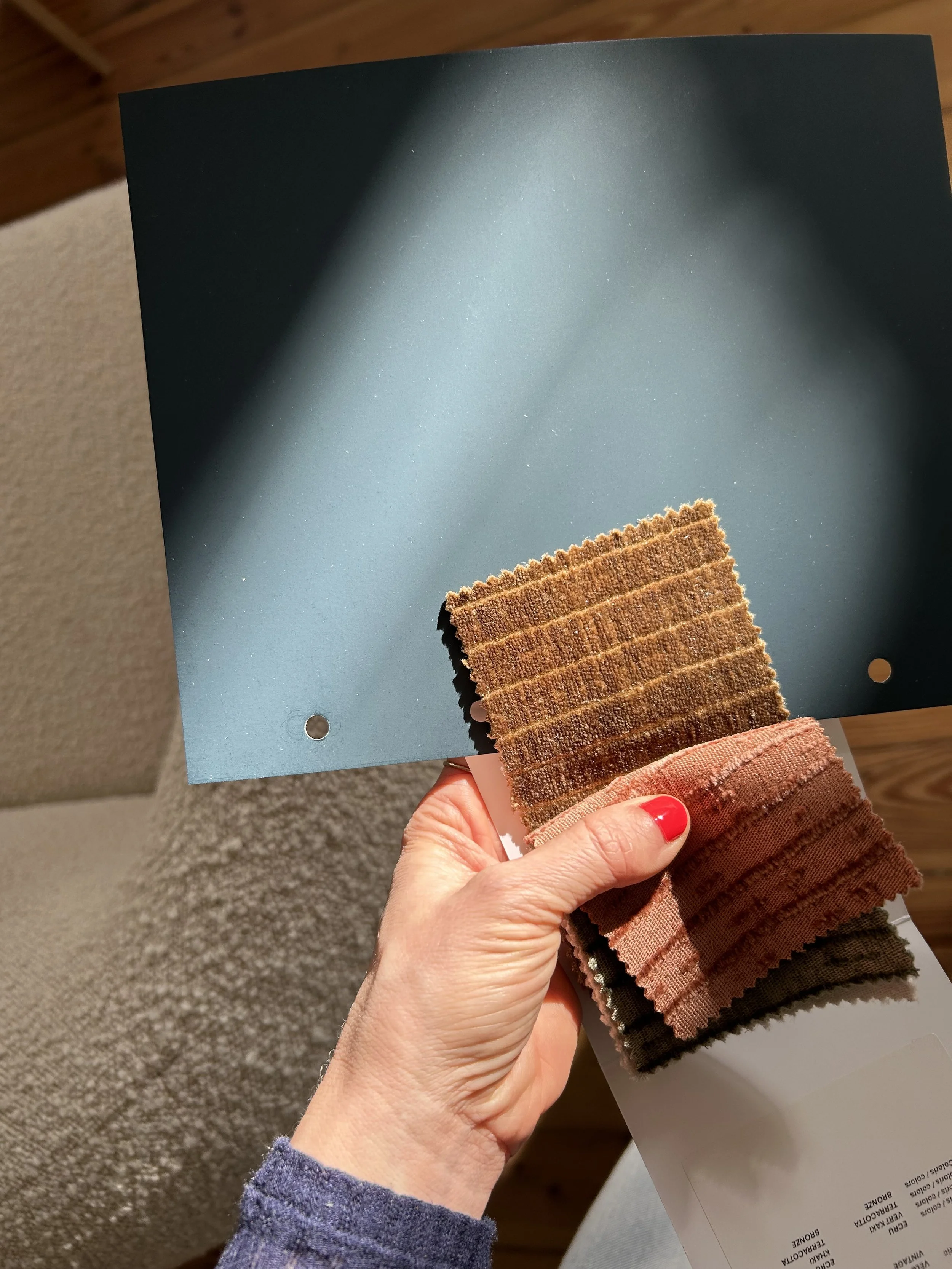
Complementary colours
Blue & orange
The monochromatic scheme
What it means is to take the colours that are sitting in the same funnel. So green, green with white, green with grey, green with black. There you just play around with different shades of that same colour. It’s much less contrast, but you have much more possibilities than what you think at first.
Once you get familiar with the wheel, you can try the other schemes like analogous, triadic or split complementary. When I work with clients, I create a colour scheme for the flat so that when you move to one of the other rooms the colours talk to each other, but also for each room on its own.
PS: If you've read this and thought 'I understand the theory, but I still don't know what to do with my flat', that's exactly what I'm here for. Sometimes it takes one session to untangle everything. You can book a free 15-min call here to see if we'd be a good fit.